
How we work together: Helping burnout and overwhelmed women get their spark back
Free Intro Call (15-20 minutes)
A no-pressure conversation to see if we're the right fit.
We'll talk about what's been going on for you, what you're hoping therapy might help with, and whether my approach feels right. You can ask any questions you have about how I work, what CBT therapy involves, or what to expect.
If we're not the right fit, I'll tell you honestly and help you think through what you might need instead. This is to make sure CBT and me are the right fit for you.
First Session (50 minutes) - Assessment
This is where we get to know each other properly.
I'll ask about what's been happening, how long it's been going on, what you've tried before, and what you're hoping will change. We'll also talk about your history, not to dwell on the past, but to understand where some of these patterns might have started.
By the end of the session, we'll have a clearer picture of what's going on.
Ongoing Sessions (50 minutes, weekly or biweekly)
This is where the work happens.
We'll use CBT to explore and challenge the beliefs keeping you stuck. We'll practice doing things differently, even when it feels uncomfortable. We'll gather evidence against any beliefs keeping you stuck
We review every 4 sessions to make sure therapy is working. If you need more than 12 sessions, we take our time. If something isn't working, we adjust.
You lead the timeline.

Is This For You?
You've been keeping it together for a long time, but it's getting harder.
You're working longer hours than everyone else, saying yes when you mean no, checking your work obsessively because mistakes feel catastrophic. You feel guilty every time you rest. You're exhausted even after time off.
You've tried the usual fixes: better time management, positive thinking, more self-care. Maybe they helped a bit…But you're still burnt out. Still feeling like you're not doing enough, no matter how hard you work.
What you're looking for:
Help that goes deeper than "just rest more" or "set better boundaries."
A space where you don't have to hold it all together or perform competence.
Support that addresses why you feel this way, not just how to manage the symptoms.
Tools that actually help you challenge the beliefs keeping you stuck, not just strategies to cope with them.
What you want:
To trust yourself instead of constantly questioning your worth.
To rest without the guilt spiral.
To say no and believe it's enough.
To make a mistake and move on, not think about it for three days.
To feel worthy and enough, even just as you are, even when it’s not perfect.
To stop just surviving and start actually living.
If that sounds like you, I can help.
What is CBT?
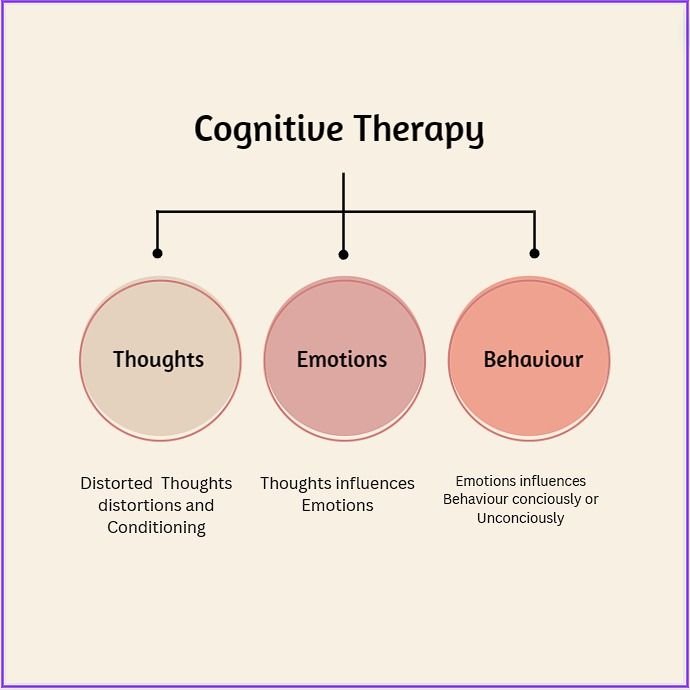
CBT stands for Cognitive Behavioural Therapy, an evidence-based talking therapy that looks at how your thoughts, feelings, and behaviours are all connected.
When you're struggling with burnout, low self-esteem, anxiety, or depression, your brain often gets stuck in unhelpful patterns. You might believe things like "I'm only ok if I'm perfect" or "I have to earn the right to rest." And those beliefs shape how you feel and what you do.
CBT helps you notice those patterns, challenge the beliefs underneath, and practice doing things differently, even when it feels uncomfortable.
It's not about positive thinking or pretending everything's fine. It's about gathering evidence that contradicts the beliefs keeping you stuck, and rebuilding trust in yourself.
CBT is particularly effective for:
Burnout and exhaustion
Low self-esteem and self-worth
Perfectionism and people-pleasing
Anxiety and overthinking
Depression
Social anxiety
Panic disorder
OCD
Phobias
Trauma and PTSD
I also use ACT (Acceptance and Commitment Therapy) and CFT (Compassion-Focused Therapy) alongside CBT when they fit. The goal isn't just managing symptoms, it's addressing the root beliefs driving them.
Your Questions, Answered
-
Currently I only work with those aged 18 and above
-
Your privacy and trust are very important. What we talk about is just between us, unless there’s a risk of harm to you or someone else. Otherwise, it’s just us figuring out how to get you to your goals.
-
Every other Monday (variety of times)
Every Tuesday and Thursday evening 6:30-7:30pm
Every Friday morning 8am-9am
Every Saturday (variety of times)
-
Sessions cost £85 pounds for a 50 minute session or £320 for a block booking of 4 sessions (£80 per session)
-
It depends. Some people feel a shift in 8-12 sessions. Others need longer. We review every 4 sessions to see how you're feeling and whether we need to adjust. If you need more time, we take it. If you're ready sooner, great. You lead the timeline.
-
No. If something's felt heavy, hard to name, or you just know you're exhausted, that's enough.
-
That's really common. Sometimes it's about fit, you and the therapist didn't click. Sometimes it's about approach, maybe the modality wasn't right for what you needed. We can talk about what didn't work and whether my approach might be different.
-
Yes. I ask for 24 hours' notice where possible. If you need to cancel or reschedule with less notice due to illness or emergency, just let me know.